Posts Tagged ‘Women’s Wisdom Project’
Marion Nestle

“Food choices are about your future and that of your children.
They are about nothing less than democracy in action.”
-Marion Nestle
Marion Nestle is one of the leading thinkers and activists when it comes to nutrition and food politics. In fact it’s hard to do any reading or research about food politics without coming across her name.
She is the author of several books, including Food Politics: How the Food Industry Influences Nutrition and Health and the most recent Soda Politics: Taking on Big Soda (and Winning).In October, she will release her latest book: Unsavory Truth: How Food Companies Skew the Science of What We Eat. She is Paulette Goddard Professor, of Nutrition, Food Studies, and Public Health, Emerita, at New York University, which she chaired from 1988-2003 and from which she retired in the end of 2017.
There was a point in my life when I debated on applying to NYU’s Master’s Program in Food Studies (a program she pioneered), just so that I could have the opportunity to have Marion as a teacher. And while I never got around to that, she has kindly answered various interview questions of mine over the course of many years as I have written about food and nutrition myself.
The quote that I decided to use for her portrait is from her book What to Eat. The book was originally published in 2006. That feels like an eternity ago when it comes to food politics. After all, it feels like a lot has changed in our conversation about food over the last decade. There are many more options at the grocery store, and the conversation about health has begun to shift to not only our personal self, but that of the environment and the workers who put food on our table.
And yet despite some of the progress that we have made, we still face many of the same problems, and some have gotten worse. Over the last decade, obesity rates have jumped. In 2007-2008, the CDC reported that 33.8% of American adults were obese. For the period of 2015-2016, that number grew to 39.8%. Food insecurity has grown a small amount as well; today 12.3% of American households are food insecure, compared to 10.9% in 2006. Some of us may have easier access to things like farmers markets, and yet, independent farmers are struggling; in the U.S. the suicide rate is double that of veterans. Systemic racism and economic inequities continue to plague the food system.
In researching this piece, I came across an interview with Marion on Civil Eats, taking a look back at her three decades of work and what has changed and what hasn’t. It’s a reminder that even when it comes to our conversation about food, the basics are still the same.
I went into nutrition in 1976. And everybody was saying, I remember quite vividly, “We want you to teach this nutrition class because there’s so much public interest in it.”
Three books had just come out. Frances Moore Lappé’s Diet for a Small Planet, which is still in print, was cataclysmic in its impact. I mean, think about what she talked about in 1975: Eat less meat, and it’ll be good for health and the environment. You know, we’re still right there.
So what’s keeping this from truly moving forward? The combination of a food and agribusiness industry that’s about high profits and high margins that don’t consider things like human and environmental health, and the political policies that are at the base of that system. Real change requires industry, infrastructural and political change.
That feels overwhelming. But what we as citizens do have control of on a daily basis is what we put into our bodies, and I keep coming back to Marion’s quote from What to Eat. Not everyone has the luxury of making choices about food, but for those of us who do, they are a way to take daily action. What we eat matters, to both ourselves and our communities.
Marion continues to be a resource yet she always provides a fresh voice. She updates her Food Politics blog regularly, and as someone who cares strongly about food and the food system, for me, she is a constant source of inspiration and wisdom.
She kindly answered a few Women’s Wisdom Project Q&A questions.
Anna: What does wisdom mean to you?
Marion: Wisdom to me means knowing enough about people and history to make thoughtful decisions about daily life.
Is there an influential woman in your life who passed along a piece of wisdom to you? Who and what?
A dean in my high school assured me that I would have a much better time as an adult.
We have been eating food for all of human history, and yet today, it seems like these days we need specialists to inform us what we should and shouldn’t eat. Do you think that we have lost our common sense in regards to what we eat? If so, why?
The food industry spends fortunes to convince us that our common sense is wrong. It’s hard to resist that kind of propaganda.
When it comes to food and food production, as we have modernized, what wisdom do you think that we have lost?
If we are to eat well in the future, we must grow food sustainably, replenish soil, preserve water quality, and do everything we can to reduce greenhouse gas emissions.
What do you see as the future of food?
No matter how many of us there are, we will still need to eat. We must plan for that.
What wisdom would you share with your younger self?
Courage!
This papercut is a part of the Women’s Wisdom Project, a project focused on showcasing the wisdom of inspiring, insightful women by making 100 papercut portraits.
Isabella L. Bird

“Everything suggests a beyond.”
– Isabella L. Bird
Born in England in 1831, Isabella L. Bird was outspoken from a young age. For health reasons, in 1854 a doctor suggested a sea voyage. This would lead to a life of travel, her adventures taking her to the U.S. (where she spent time in Colorado, riding horseback across the Rockies), Australia, India, Kurdistan, Turkey, Morocco and many more.
Bird wrote about her adventures in several books, likeA Lady’s Life in the Rocky Mountains, and was a respected photographer and naturalist, exploring and documenting the world around her. In 1892, she became the first woman fellow of the Royal Geographical Society.
Imagine being a female adventurer in her day – a time when women were expected to stay home, to stick to their routines. She upended all of those expectations, fueled by an interest in adventure and a desire to tackle new challenges. In Colorado, she became the first woman to climb Long’s Peak, nowadays one of the state’s most popular “fourteeners.”
It’s so easy to only focus on the minutiae of the world around us; our to do lists, our daily lives, our routines. But Isabella’s quote is a reminder that there is always more; a challenge to open our eyes, to look beyond, to think differently. The world is full of potential for discovery, whether it’s far away or in our own backyard. We simply have to open ourselves to it.
This papercut is a part of the Women’s Wisdom Project, a yearlong project focused on showcasing the wisdom of inspiring, insightful women by making 100 papercut portraits.
Rachel Carson
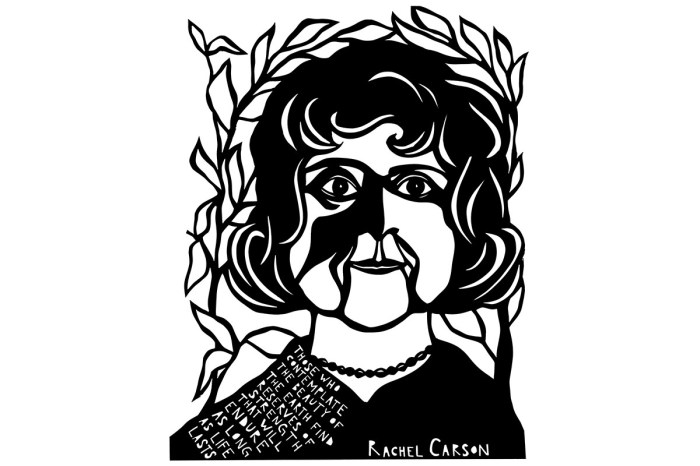
Writer, scientist, ecologist, conservationist, activist. Rachel Carson was many things, and her work continues to be instrumental today.
Her book Silent Spring, published in 1962, galvanized the environmental movement (and also pissed off the chemical industry; Monsanto published 5,000 copies of a brochure parodying the book). But her writing extended far beyond that. In fact, she was first published at the age of 10 in a children’s magazine. She was a woman ahead of her time; in 1936, she was the second woman hired by the U.S. Bureau of Fisheries.
Carson believed in the wonderment that comes from the natural world, and she sought to share that with her readers, reminding us that we are but a part of the larger system around us.
The quote that I used in this portrait of hers is part of a longer one from Silent Spring, and I wanted to share in its entirety:
“Those who contemplate the beauty of the earth find reserves of strength that will endure as long as life lasts. There is something infinitely healing in the repeated refrains of nature — the assurance that dawn comes after night, and spring after winter.”
And if we contemplate and understand the beauty of the earth, it becomes that much harder to continue to act in a way that destroys it.
This papercut is a part of the Women’s Wisdom Project, a yearlong project focused on showcasing the wisdom of inspiring, insightful women by making 100 papercut portraits.
 blog.annabrones.com