Posts Tagged ‘Women’s Wisdom Project’
Greta Thunberg
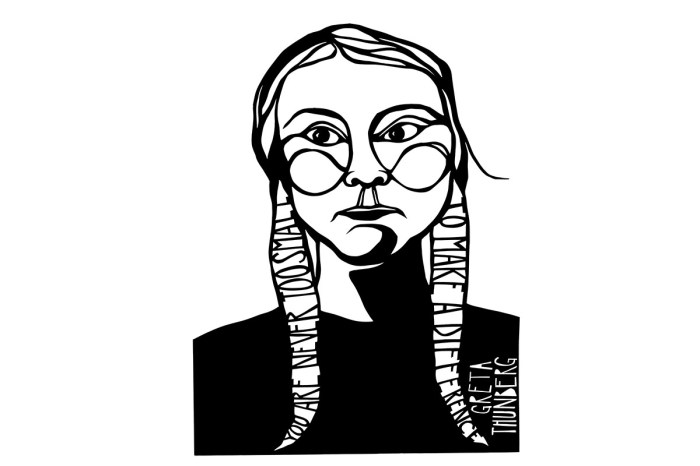
“You are never too small to make a difference.”
-Greta Thunberg
Greta Thunberg is 16, and last August when it was time to go back to school in her city of Stockholm, she decided to strike instead. It had been a record hot summer, and she wanted to do something about climate change. So she sat outside of Swedish Parliament, with her now famous sign “skolstrejk för klimatet” (school strike for the climate). She handed out fliers that said “you grownups don’t give a shit about my future.” After three weeks, Thunberg went back to school, but she kept striking every Friday, and others joined her.
I was in Stockholm in November, and walking on a cold Friday afternoon I saw the strike. I remember feeling inspired, but also sad, thinking of the situation that these young people currently face, and of the future yet to come. I was in my own head focused on other things, and I didn’t stop to talk to them. Now of course I wish I had.
Today, March 15, 2019 students have taken to the streets around the world for the global climate strike (also known as Youth Climate Strike, Fridays For Future). What started as one girl’s insistence that something needed, and could be, done has turned into a massive movement. Thunberg was nominated for the Nobel Peace Prize this week. If you haven’t watched her UN Climate Change COP24 or TEDxStockholm speech please do. And if you haven’t been following the global youth movement that is growing day by day, do that as well. It feels like a flicker of hope in dark times.
“This movement had to happen, we didn’t have a choice. We knew there was a climate crisis. Not just because forests in Sweden or in the US had been on fire; because of alternating floods and drought in Germany and Australia; because of the collapse of alpine faces due to melting permafrost and other climate changes. We knew, because everything we read and watched screamed out to us that something was very wrong,” she and other young leaders wrote in a global op-ed.
Support them, raise their voices, join in. Remember that none of us are too small to make a difference.
This papercut and profile are a part of the Women’s Wisdom Project, a project focused on showcasing the wisdom of inspiring, insightful women by making 100 papercut portraits.
Simran Sethi
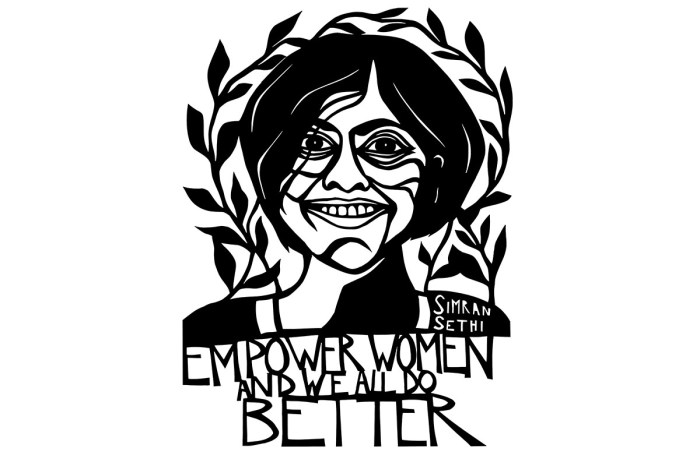
“Empower women and we all do better.”
-Simran Sethi
Journalist, writer, podcaster, speaker, professor: Simran Sethi is many things.
Her work centers around food, sustainability and social change, and whether she’s penning an article about bees for the Smithsonian, podcasting about chocolate, or speaking at a conference, whatever medium she uses, she is committed to connecting with people.
In 2015 she published an excellent book titled Bread, Wine, Chocolate: The Slow Loss of Foods We Love. That book is ever more topical given the recent United Nations report on the shrinking biodiversity and the risk for global food and agriculture. For example: while 6,000 plant species are cultivated for food, just nine of them account for two-thirds of all crop production. If we don’t prioritize biodiversity and conservation, we are in risk of a serious crisis.
Sethi and I have only met in person once, but thanks to this thing we call the Internet, we have been able to cultivate a friendship. I have a deep respect for the work that she does, and over the course of knowing her, I have discovered many of the commonalities that we share. We had a long conversation last summer, and I only recently got around to transcribing it.
It was so refreshing to listen to it after all this time, the things that we talked about are still relevant and I found myself appreciating this new dose of wisdom from her.
Who is Simran Sethi?
I’m a writer and I’m a professor of journalism and have been a podcast and broadcast journalist and documentary filmmaker. I’ve had a number of different designations, but all of them at their very core are about creating something. For me the act of creation is one very specific intention of helping people make better decisions in their lives, providing the kind of information that will support some small or large level of transformation.
You told me that a woman who you shared an apartment with when you were teaching in Rome last summer referred to you as an artist, and that you really appreciated that. Why do you think you haven’t referred to yourself as an artist?
I’m still pretty new to referring to myself as a writer. It has taken me a long time to do that. I mean, even after a major house published my book, I would apologetically and sheepishly say, “I wrote a book.” Probably it comes from very early on in my childhood. My family and I immigrated from Germany, but my parents are of Indian origin. As far back as I can remember, my father gave me five job choices: teacher, lawyer, engineer, doctor, or scholar. My mom encouraged actual artistic creativity in my sister, but I was the bookish one, with glasses at age six, reading a lot. I didn’t see myself as, A: someone who a was creative, or B: was allowed to be creative.
It’s so interesting to me that so many people say “I’m not creative,” even though it’s not a thing that we inherently have or don’t have. It’s something that we can work on. Everyone gets to be creative, no matter whether you’re an engineer or an illustrator. I wonder what it is that’s kept us from embracing that culturally.
I think it even ties in to the notion of a storyteller. Certain people claim that mantle, but we all are telling stories every day. Like I write in my book, we’re made of story. I firmly believe that: we’re engaged in creative acts every day. Whether it’s a spreadsheet, a book or a loaf of bread. We can look to the age of rationalism and philosophers like Descartes, and I can’t really go too far down that road, but I think there’s something there separating out an artist from a thinker, as if these things are mutually exclusive. They are not, they are embedded in each other.
When you think of the word wisdom, what does it mean to you?
The first idea that comes to mind is roots going deep. And the distinction I would make between being smart and being wise. Wisdom feels like a grounded knowledge, being centered and steadier in yourself. To describe someone as wise, to me is to describe someone who is not only knowledgeable about the world, but has a deep relationship with their inner world.
Is there an influential woman in your life who passed along a piece, or sense, of wisdom that you can remember?
It sounds a bit cliche, but the person who has done this the most, is my mother, with little dust bunnies of wisdom. So much of how I felt about recent decisions that I have made have been elevated by her support. I live a pretty nomadic existence, and there’s a part of that absence of a singular home that feels weird and ungrounded. My mom reminds me how remarkable these decisions are, how lucky I am, how her life would have been so different if she had been allowed to make different kinds of decisions. Her feedback and insights have been really reaffirming for me.
How do you stay grounded within that existence?
I’ll share with you what I share with my mother, to reassure her: I have to find “home” within myself. I used to be a labor support doula, helping women during childbirth. When you’re actually birthing, you’re not moving, you’re birthing, right? You’re walking around ahead of time, you’re rocking or on your hands and knees or doing whatever you do. But in the moment when you’re pushing that life into the world, you’re stationary.
It’s a little bit difficult to drop down into my creative work when I am moving; I have to find still points. And I also know the movement feeds the work. In many cases, it is the work: taking in the world and bringing it back to my respective audiences – whether in print or on a podcast.
I feel like that constantly, that I need solitude and stillness to create the work, but I need movement to inspire the work. That is a tough balance to find.
Exactly. It’s dynamic. So many things feed us. It’s a gift. And, at the same time, I occasionally – rarely now but still – feel like, “Wouldn’t it be nice to live a calmer, contained life?” To pick the kids up from soccer, to make dinner with the husband, et cetera.
I have been thinking a lot about what women have to contribute. And I was thinking about all of your work in chocolate, meeting women on the ground. What are some of maybe the old traditions are wisdoms that they have that can help to move us forward in a sustainable way?
Women have a much harder time getting access to capital and land. Yet, they’re the ones who, with whatever money they earn, do a much better job at sustaining the household. It’s just so simple, right? Empower women and we all do better, our entire society will be better. If you give women access to education, credit, work, leadership positions, things will be better.
There’s this one collective of women farmers I met in Dominican Republic who make chocolate. I referenced then in a story I wrote for Yes! magazine. All they wanted was be treated the way the men were and to earn enough money to have some agency in decisions in around their families. Some of them are farmers, but they’ve now also moved into making this value added product, chocolate. The way I saw them take care of each other at the conference where we met, and what I learned about how their role in their communities were being elevated as they were seen as business people. It was quite inspiring.
From a global perspective, women feed us. We grow the crops, we make decisions around food purchases and make the food. We nourish. But these acts have also been taken from us. Women were the first people who made beer – they were called “ale wives” – women were the first to make farmhouse cheese, and so on. It’s only when these kinds of drinks and foods become commodities – when it’s taken away from the province of the home – that they seem to accrue value.
I want to continue to be somebody who calls attention to that and does whatever I can to help shift perceptions around who – and what – women are. I don’t fully know how that will play out but it starts, I think, with what you’re doing: elevating women’s voices.
This papercut and profile are a part of the Women’s Wisdom Project, a project focused on showcasing the wisdom of inspiring, insightful women by making 100 papercut portraits.
Aminatou Sow and Ann Friedman
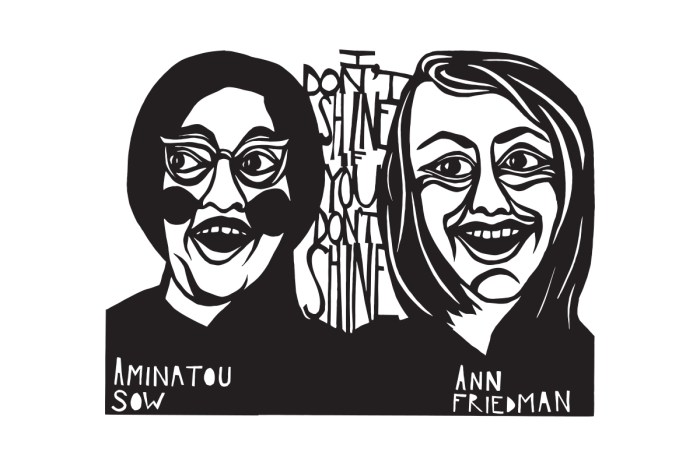
“I don’t shine if you don’t shine.”
– Aminatou Sow and Ann Friedman
I am a big fan of the work of both Aminatou Sow and Ann Friedman. I wanted to feature both of them as part of Women’s Wisdom Project and it felt fitting to put them together, since they are a masterful duo.
Listening to them on their podcast Call Your Girlfriend feels like hanging out with friends; friends who inspire you to be better. Their show makes me want to read more, ask more questions, create more art, have more fun. I also love their Shine Theory concept which this quote comes from. (And yes, they have a shared quote because I think we all need a reminder of how much wisdom we all share with each other on a regular basis.)
A little extended excerpt from Shine Theory:
“Shine Theory is an investment, over the long term, in helping someone be their best self—and relying on their help in return. It is a conscious decision to bring your full self to your friendships, and to not let insecurity or envy ravage them. Shine Theory is a commitment to asking, “Would we be better as collaborators than as competitors?” The answer is almost always yes.”
YES. We don’t create in a vacuum and we don’t succeed in a vacuum. We have to build up a team of people who believe in us, support us, and inspire us.
This papercut and profile are a part of the Women’s Wisdom Project, a project focused on showcasing the wisdom of inspiring, insightful women by making 100 papercut portraits.
Kamala Harris
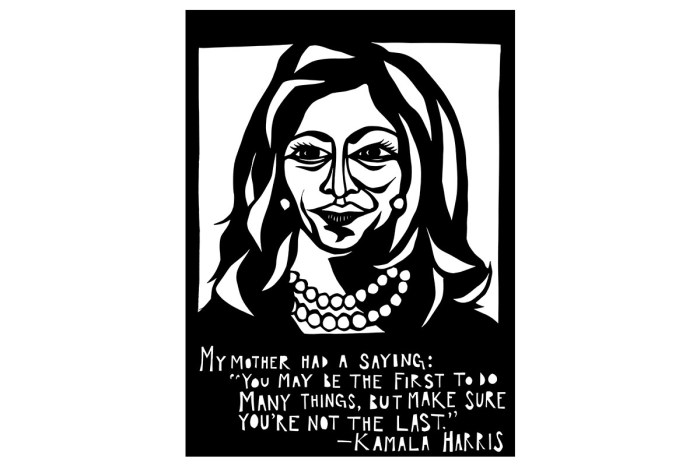
“My mother had a saying: ‘you may be the first to do many things, but make sure you’re not the last.'”
-Kamala Harris
I have returned to this quote so many times since making this papercut of Kamala Harris. That’s for two reasons.
First, I love asking fellow women about an important piece of wisdom they have learned in their lives. Most often, it’s something passed along to them by someone close: a mother, a grandmother, an aunt, a sister, a close friend. So when I saw that Harris had shared this sentiment from her own mother, it really resonated.
We have a tendency to gravitate to the words of writers, artists and thinkers that we don’t know. There’s something about a knowledgeable person sharing a tidbit of information that feels meaningful, valuable. There is also power in the ability to condense complex emotions and concepts into words. It’s why books can resonate so much, why a good speech can bring us to tears.
But as it turns out, some of our most cherished wisdom comes from our closest connections. No matter who we are, we have so much to offer each other.
The second reason that I feel moved by this quote is what’s in Harris and her mother’s words. They remind us that our actions help to set a stage for the future.
I actually made this papercut before Harris announced her presidential campaign, but I believe that her running, as well as other female candidates like Elizabeth Warren and Kirsten Gillibrand, does help to set that stage. Whatever we do, when we take action, we have to ensure that those actions are contributing to building a platform that supports others.
After all, we are only as powerful as the groundwork that we build for future change.
This papercut and profile are a part of the Women’s Wisdom Project, a project focused on showcasing the wisdom of inspiring, insightful women by making 100 papercut portraits.
Charlotte Brontë

“Cheerfulness, it would appear, is a matter which depends fully as much on the state of things within, as on the state of things without and around us.”
-Charlotte Brontë (1816-1855)
This quote is from Charlotte Brontë’s novel Shirley, her second novel published after Jane Eyre, originally published under Brontë’s male pseudonym, Currer Bell.
Brontë, as well as her sisters, are often seen as feminist icons, revolutionaries who questioned the social norms of their time. “…in 1847, Brontë was a gateway to the future (as the fact that we are reading her today so neatly proves). She lived in a sophisticated and complicated world, one whose codes and unwritten rules, whose morality and intellectual structure, would baffle even the most learned among us,” writes Sam Jordison in the Guardian.
Constance Grady, in an article for Vox, puts it this way: “What animates the Brontë sisters’ work is a specifically feminine anger in response to their patriarchal society, a feeling of being hunted and trapped and confined and degraded that is peculiar to women of great intelligence and few opportunities and resources.”
It’s an interesting thing to take quotes out of context, which is basically what we do every time we write down a quote, share a quote, illustrate a quote, say a quote out loud. By identifying just a few sentences, we focus deeply on the meaning of the chosen words, not necessarily the entirety of where they came from. We take the words and give them our own meaning. I think about this every time I work upon a Women’s Wisdom Project piece, conscious of my own role in perpetuating this obsession with simplifying complex ideas, thoughts and identities into just a few sentences.
I think I happened upon this quote of Brontë’s at the library when I had briefly picked up one of those books about positive thinking and cultivating a more balanced life to flip through briefly. The book did not speak to me but the quote did, and I noted it down for later, perhaps because the reminder of the necessity to cultivate inner contentment is always needed.
But of course, I have no knowledge of what the line would have meant to a reader in Brontë’s time, or even what her intention was in writing it. After all, Shirley is a social chronicle, focused on life in industrial England. This was not the day and age of Marie Kondo, mindfulness or minimalism, it was a time of survival.
And yet, I believe that these words of Brontë’s hold true for a variety of contexts. If we define ourselves simply by the situation around us, we might never question that situation, or work to change it. An external situation may fuel our rage, but it is how we deal with that situation that matters.
In that sense, for me the wisdom in Brontë’s words is this: to come to terms with our inner selves is not only our source of cheerfulness, it is our source of power.
This papercut and profile are a part of the Women’s Wisdom Project, a project focused on showcasing the wisdom of inspiring, insightful women by making 100 papercut portraits.
Lucy Stone
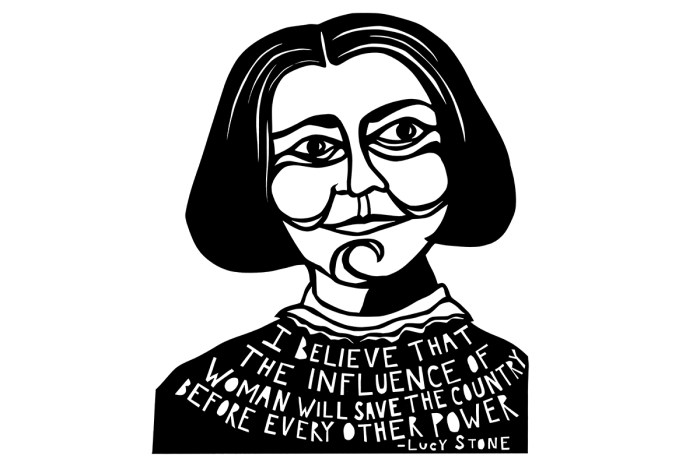
“I believe that the influence of woman will save the country before every other power.”
Lucy Stone (1818-1893)
The first Massachusetts woman to earn a college degree (from Oberlin College), Lucy Stone is famously known for being the first American woman to keep her last name when she married. It was 1855 and she was a woman ahead of her time; at her wedding ceremony, she read a “marriage protest,” a statement that she and her partner Henry Browne Blackwell had written together, denouncing the legal portions of a marriage in which a woman became subservient to and property of her husband.
But her actions were not just in the private sphere.
Stone was a fighter for both women’s rights and an abolitionist, believing that equality could not be won at the cost of inequality of another. In 1848, a year after her graduation from Oberlin, she began working as a paid lecturer for the Massachusetts Anti-Slavery Society and quickly became known for her voice and strong views. She soon began speaking up for women’s rights too, and became one of the preeminent leaders of the movement. She organized the 1850 Worcester First National Woman’s Rights Convention and was the publisher of the women’s rights periodical Woman’s Journal.
“I believe that the influence of woman will save the country before every other power,” Stone said at a May 12, 1869 anniversary celebration of the Equal Rights Association, as quoted in the book History of Woman Suffrage. But while she stood for women’s rights, she was also an abolitionist and in support of the 15th amendment, which granted African American men the right to vote. Her views led to breaking with suffragists Elizabeth Cady Stanton, Susan B. Anthony, and others.
When members of the Equal Rights Association refused to consider an amendment to give women voting rights, Stanton and Anthony left to create the National Woman Suffrage Association. Stone and others formed the American Woman Suffrage Association. The schism in the women’s movement highlights the complex interplay between racism and sexism of that era, an interplay that still continues today.
Stone eventually saw the reunification of the two organizations in 1890, coming together as the National American Woman Suffrage Association. While she had seen the abolition of slavery in her lifetime, her death in 1893 came before the ratification of the 19th amendment , and she never saw women granted the right to vote. But her tireless efforts had laid the groundwork for a different future for her daughter, who also went on to work as a feminist and abolitionist. As Stone lay dying, she said, “I am glad I was born, and that at a time when the world needed the service I could give.”
This papercut and profile are a part of the Women’s Wisdom Project, a project focused on showcasing the wisdom of inspiring, insightful women by making 100 papercut portraits.
Rebecca Burgess

“You have to look back to know how to move forward.”
-Rebecca Burgess
Back in 2010, Rebecca Burgess set out with an ambitious goal: to see if she could create a wardrobe that was grown, processed and made within 150 miles of her home in northern California. Along with a team of other women, she crowdfunded the project. But what grew out of this endeavor was in fact much more than a wardrobe; Burgess launched a movement.
The project evolved into what is now Fibershed, an organization devoted to developing regional and regenerative fiber systems. Based in California, Fibershed has affiliate groups around the world, all working on reviving and growing local fiber systems, communities and economies.
Burgess is also a climate activist, and an advocate of carbon farming, a holistic method of farming that sequesters carbon. Fibershed has an entire program devoted to climate beneficial wool which not only supporters producers who are sustainably managing their land and animals, but also works with brands and designers to turn that fiber into products and bring them to market. Last year Fibershed teamed up with The North Face to launch the Cali Beanie, made with climate beneficial wool sourced in California, and the organization also hosted a climate beneficial fashion gala.
The organization also has a program focused on the development of a regional indigo industry, and another one on hemp. Their work has help to kickstart a new generation of U.S. fiber and textile systems, helping people to start to think about what they wear like they think about what they eat. After all, without agriculture, we don’t have food or fiber, and investing in sustainable agriculture systems is the only way that we can move forward.
Her tireless work makes her a force for change, but I think what makes Burgess such a symbol of wisdom is that she is approaching that change in a slow and intentional way. When we connected over phone, she had just returned from a trip to Europe, investigating local textile and agricultural systems in places like Norway and Sweden. In our conversation we talked about everything from an appreciation of landscape, to slowing down, to how to manage our anxiety in an increasingly complex world.
Grab a mug of tea and settle in.
Anna Brones: What does wisdom mean to you?
Rebecca Burgess: Very general, broad brushstrokes that you’re pulling from a collective, more timeless source of information and synthesizing that in some way that works for the context of now. I think wisdom is tethered to time. It doesn’t mean you have to be old to have it, it just means you have to look back to know how to move forward.
Wisdom to me is about knowing how things have come to be and understanding the cycles. Everything comes back around, it just might sound, feel, taste, look a little different. But all these human things that we’ve been dealing with – our own anger, frustration and aggression, joy, bliss, happiness – all these human emotions have been guiding civilization, for better or worse, for as long as we’ve been here on planet earth. I think wisdom is about understanding the drivers for how civilizations have come and gone and understanding how to work collaboratively with our planet and each other. And I think that to do that, you need this thing called wisdom, which is tethered to time.
Cheryl Strayed
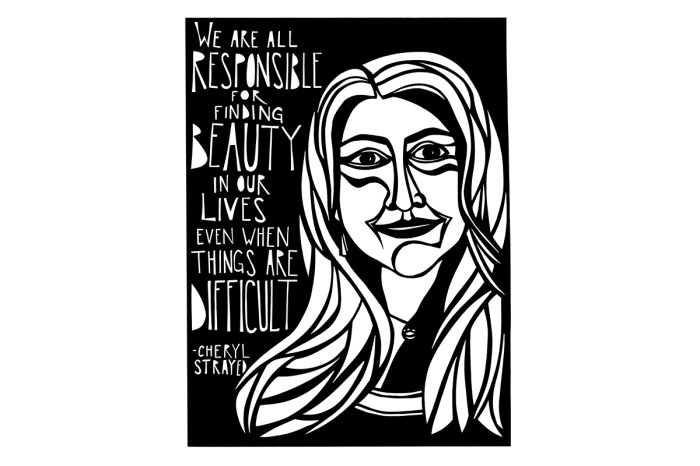
“We are all responsible for finding beauty in our lives even when things are difficult.”
-Cheryl Strayed
At the end of May, I was lucky enough to sit down with Cheryl Strayed and interview her for the Women’s Wisdom Project. Cheryl and I had met a few times over the years while attending Mountainfilm, and I was honored that she graciously offered to spend an hour with me talking about all things related to wisdom.
Of course, I knew that this conversation would need to go a little above and beyond just a papercut portrait, or even a Q&A. So I asked my friend Gale Straub at She Explores if she would be interested in having me record the interview and we could turn it into a podcast. I got another yes, and soon found myself nervously preparing to record an interview with a new recording device that I had never used.
I say this because I think that context is everything. There’s always a back story, and in this case, the back story was that I wanted to doing something that I really didn’t know how to do (audio recording), and doubt and fear immediately kicked in at the back of my mind (“what if you ruin this audio entirely?”).
I dove in anyway.
Cheryl and I had a wonderful conversation. It’s a conversation that I have thought about so many times since. As for the audio? Well, it wasn’t perfect. But Gale (with a lot of work, that I am very grateful for) managed to turn it into a podcast episode, which you can listen to here.
It was a reminder that you have to push past fear. That things won’t always be perfect, but you’ll learn along the way. That’s a lot of what Cheryl and I talked about in our conversation. I replayed this part of our interview a few times as I was working on putting this piece together:
“One of my quotes in Tiny, Beautiful Things and in Brave Enough is that you give fear a seat at the table. You say, ‘welcome fear, your presence is an indication to me that I’m doing the work I’m meant to be doing.’ Because fear is part of our best work.”
Fear is part of our best work. Remember that.
I encourage you to listen to the podcast, but I wanted to capture some of my favorite parts of the interview here so that you could read them as well (including a couple of things that didn’t make it into the podcast).
I listened to this interview several times, wondering what bit of wisdom I would pull from Cheryl to use as the quote in her papercut. That’s the thing about quotes; they are always snippets, and this conversation was so rich, there was no way to boil it down to one sentence.
But there was one that stood out: “We are all responsible for finding beauty in our lives even when things are difficult.” Even Cheryl will admit that this bit of wisdom isn’t hers. It’s her mother’s. I chose it, because I think that it embodies the fact that wisdom is all around us, that it’s never just “ours.” Wisdom is passed down, it evolves, we offer it to others, and they pass it along to someone else.
We have so much to share with each other, and most often, the most meaningful wisdom and advice that guides is doesn’t come from a notable public figure, but in fact, from the people closest to us.
Anna: You are a prime person to talk to about wisdom, because I think a lot of people seek wisdom from you.
Cheryl: It’s always strange for me to hear that I’m some sort of fount of wisdom and that’s always been the funny, an uneasy position that I’ve been in, not just as an advice giver as Dear Sugar, but even my other books Wild and, and my novel Torch. My books have always been read in this way that people take from them advice. So much of what I’ve been interested in as a writer is our emotional lives, our relationships, the ways that we love and lose and suffer and recover and grapple with how to be in the world.
What ends up happening is because I have spent so many years really examining that and thinking about that and writing about that, I ended up seeming like this figure, this wise woman. And I have to say, it makes me laugh because because I’ve got so much to learn. I think maybe part of the thing I feel grateful about when it comes to wisdom, it does come from that place of having a lot to learn and it comes from that place of being somebody who has had to do a lot of living and a lot of experiencing and a lot of loving and losing and making mistakes and making amends and trying to figure out the better way.
Clara Barton
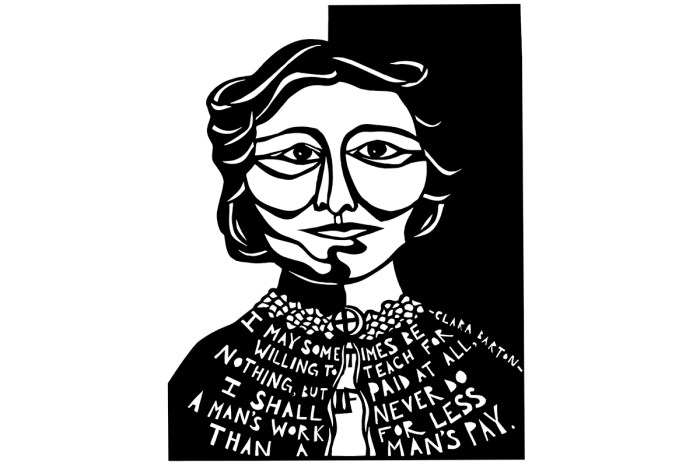
“I may sometimes be willing to teach for nothing, but if paid at all,
I shall never do a man’s work for less than a man’s pay.”
-Clara Barton (1821-1912)
Educator and humanitarian Clarissa “Clara” Harlowe Barton is most famously known for founding the American Red Cross.
She was also a strong supporter of women’s suffrage, and her quote is a reminder of how long we have been fighting to receive equal payment for work. She had started teaching at the age of 18, and even founded a school for workers’ children at the mill where her brother worked. She went on to establish the first free school in 1852, in Bordentown, New Jersey. It was at this school that she learned that a male colleague who had been hired was earning double her salary. She quit.
In 1861 she began carrying supplies to Union soldiers, making it her mission to help those in need. While she had no formal training, her care and attentiveness earned her the title “angel of the battlefield.” It was after the war that she went to Europe, where she learned of the work of the International Red Cross, an organization which called for international agreements to protect the sick and wounded during wartime and for the formation of national societies to give aid voluntarily on a neutral basis. When she returned, she was committed to starting a US-based organization that would be part of the same network, founding the American Red Cross in 1881. For the rest of her life, she continued to be a tireless advocate of those in need.
Her home in Maryland became a National Historic Site in 1975, the first dedicated to the achievements of a woman. You can learn more about Clara over on the National Women’s History Museum website.
This papercut is a part of the Women’s Wisdom Project, a project focused on showcasing the wisdom of inspiring, insightful women by making 100 papercut portraits.
Wangari Maathai
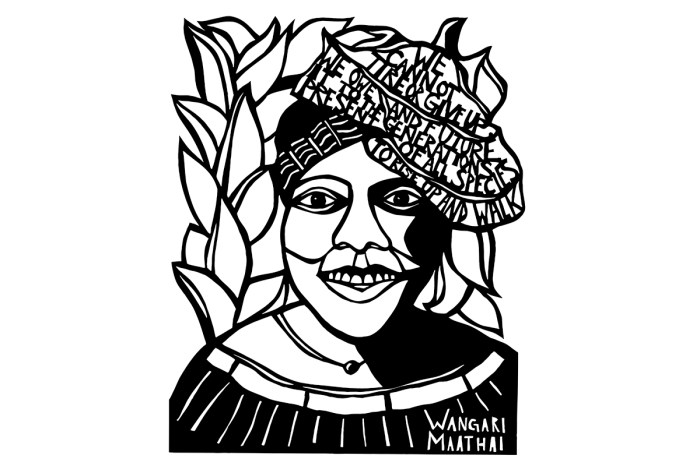
“We cannot tire or give up. We owe it to the present and future generations of all species to rise up and walk!”
-Wangari Maathai
Born in rural Kenya, Wangari Maathai was the first woman in East and Central African to earn a doctorate degree, which she was granted from the University of Nairobi in 1971. In the late 1970s and early 1980s, she served on the National Council of Women of Kenya. It was here that she came up with the idea of planting trees, a concept that she grew into a large scale, grassroots organization, the Green Belt Movement, focused on conserving the environment and improving the lives of women. Planting trees meant planting hope, a form or protest and renewal, fighting oppression with growth.
Environmentalist. Activist. Human rights advocate. Writer. Her work was inspired by her roots, but reached a global audience, and in 2004 she was awarded the Nobel Peace Prize.
I was recently reading Terry Tempest Williams’ book When Women Were Birds, and learned that the two had met in the early 1980s, and Wangari had become mentor of Terry’s. Terry herself had been inspired to start the Green Belt Movement of Utah.
Terry writes, “When I once asked her what she had learned from planting trees, she said, ‘Patience.'”
That sentiment stuck with me. Patience. It’s the same sentiment that’s in Wangari’s quote above.
The patience to speak up.
The patience to listen.
The patience to rise up.
The patience to continue.
I wonder what wisdom Wangari would give to us today. I think it would still be the same. We must continue to rise up and walk. We must be patient and persistent.
This papercut is a part of the Women’s Wisdom Project, a project focused on showcasing the wisdom of inspiring, insightful women by making 100 papercut portraits.
 blog.annabrones.com