You Are Enough
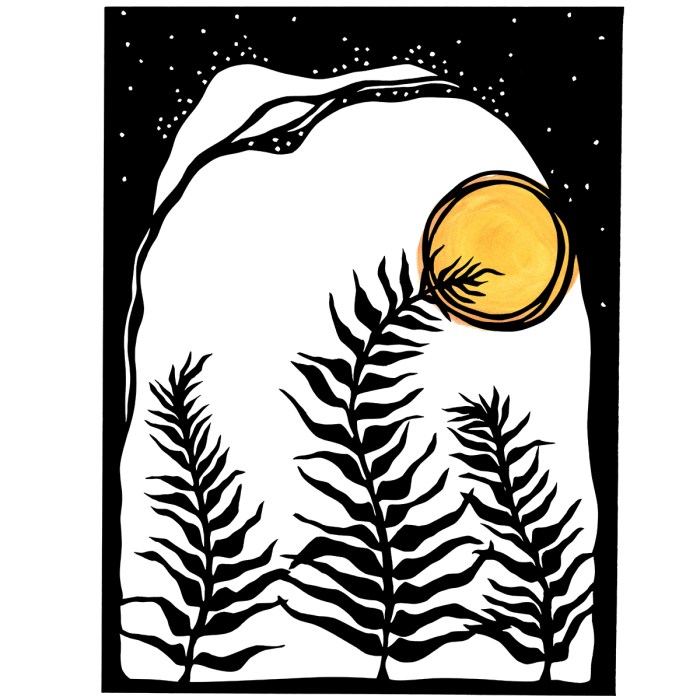
When I was 16, I was offered a scholarship to go on a 21-day Outward Bound course in the High Sierras. While I had spent ample time outdoors, I had never been mountaineering before, and never on a backpacking trip that long. I would go and spend three weeks navigating the backcountry with strangers, all of us in that awkward teenage stage where we were already trying to navigate our own lives, trying to find our way across the invisible map that is life.
I don’t remember packing for the trip (I’m certain there was a list) and I don’t remember the flight down to Fresno, where we all met before hopping into vans and heading to base camp. I don’t even remember what base camp looked like. All I remember was that feeling in the pit of my stomach as I lay in my sleeping bag trying to fall asleep.
It was that slightly warm, slightly spiky feeling, one could call it “butterflies,” but that sounds too light, too friendly, too sweet. This is the kind of feeling that’s uncomfortable and off-putting, you might want to throw up, but you’re not really sure. You’re uncomfortable certainly, but not enough to indicate the kind of fear that’s intense enough to make you stop what you’re doing. And so you stick it out.
This is a feeling that I have experienced throughout my life, and still do. It’s a feeling of fear and trepidation, it’s a feeling of standing on the edge of a precipice and diving into the unknown, it’s a feeling of anxiety, it’s a feel of nervousness, it’s a feeling of not being good enough, or not being equipped enough to take on the task at hand. It’s a feeling that says, “I’m out of my comfort zone and I’m not so sure I want to be here right now.” Age has taught me that this is a feeling to be endured, because there’s usually good stuff on the other side.
This week I taught an outdoor cooking class. I spent most of the class being upbeat and effusive, throwing ingredients together without measuring them, spewing off ideas for variations that one could try, and generally trying to get the class to be excited about making food outdoors. Internally, there was a different scene taking place. “You’re not outdoorsy enough to be teaching this class. When did you last go backpacking? Three years ago? What do you know about packing light? You only go bike touring, that’s not outdoorsy enough. When was the last time you even cooked a meal outside? Two weeks ago when you went on a bike camping? Yeah, but that was an easy overnight that’s very close to home. What’s adventurous about that?”
I am not the only one to deal with that voice. We all have it. We all experience impostor syndrome on some level. The feeling that we are not truly qualified to be doing the thing that we are doing.
What Blocks Our Creative Flow? (And How Do We Get Back There?)
Creative flow is that sought after state that so many of us keep wanting to get to. When we’re there, we feel strong and empowered, as if we are doing exactly what we should be doing in that exact moment. We may work hard, but in a sense, that work feels effortless. When we’re not there, that state feels more elusive than ever, and we try to think of every possible means of chasing it down, hoping to harness that power once more.
But what is creative flow? When and why do we get into that state?
“The best moments in our lives are not the passive, receptive, relaxing times… The best moments usually occur if a person’s body or mind is stretched to its limits in a voluntary effort to accomplish something difficult and worthwhile,” wrote Mihaly Csikszentmihalyi in his book Flow.
That’s what we feel when we are in that moment of creative flow. We are immersed in what we are doing, everything else falls away. This doesn’t just happen in creative practice. Ever felt a runner’s high? That’s because of flow. Or when you come out of an hourlong yoga practice and realize that you haven’t thought about anything else in the last 60 minutes besides your physical presence? Flow.
I found a segment from WNYC from a couple of years ago on the neuroscience behind creative flow, featuring an interview with Dr. Heather Berlin. “Productivity doesn’t necessarily correlate with creativity,” says Berlin. An excellent reminder that just because we are producing work doesn’t mean that we are being creative or doing creative thinking. Some of the best stuff comes to us when we’re on a walk, or staring out the window. That’s because, “the unconscious can do much more complex processing,” says Berlin. The creative flow state can’t be forced. In those moments it’s better to turn off and tune out.
In her interview, Berlin mentions a study that involved MRI scans of jazz musicians’s brains while the musicians were improvising. This study is about ten years old, but the lessons to be drawn from it are timeless. According to Science Daily, “The scientists found that a region of the brain known as the dorsolateral prefrontal cortex, a broad portion of the front of the brain that extends to the sides, showed a slowdown in activity during improvisation. This area has been linked to planned actions and self-censoring, such as carefully deciding what words you might say at a job interview.”
In other words, if we can turn that part of the brain off – or at least put it in pause – we might be better able to lower our inhibitions and better tap into our flow state.
Earlier this week, someone asked me what my writing process was. I would love to say that I diligently sit down on a regular basis and write for a predetermined amount of time, avoiding all distractions and committing myself to the process. I can think of about one month in the last year and a half when I was good about doing that (and I managed to write a book in that month, which I guess is proof that such commitment does work). However, for the most part, my writing process is what I call the “marination method.” I have an idea, or an assignment, I file it away at the back of my brain, and let the idea sit and percolate. Eventually the deadline nears, and I have to put pen to paper, or fingers to keyboard, and release those ideas.
Often I feel that I am up against a block, and in those moments I know that before I can sit down and do the work, I have to do something to get the creative juices flowing. A creative warm up so to say. That can be a run or a walk, or just taking a few minutes to paint with watercolors. (Sidenote: I am avoiding a deadline at this very moment, but telling myself that writing this is a good way to warm up to finishing the piece I need to turn in). Something to get my mind away from focusing too hard on the project at hand, and letting it wander instead. Often I find that somewhere in this process the unconscious kicks in, things come to the front of my mind that I hadn’t even considered. When I finally get there, then I feel like I am in the flow state.
I’m not necessarily advocating for that as a writing strategy, but in the moments when we feel that we are up against those creative walls, it’s an important reminder that pushing through isn’t necessarily the best path forward. If you let the prefrontal cortex do too much obsessing, you’ll keep coming up against that block. One study even used targeted electric currents to block that part of the brain, showing that doing so can help to break down that wall and lead to more creative thinking.
But we don’t need electric currents to stop obsessing. Think of another use of flow: physical movement. Exercise is good for our creativity. Intuitively, I think it makes sense that physical movement would lead to creative movement.
If we’re looking for that creative flow state, we have to do the things that get us there. There’s no magic solution, but you can be sure that refreshing your email isn’t one of them.
Stay small; often we don’t have an entire day to devote to a creative project, instead, think about what you could do creatively in fifteen minutes. If you can do those fifteen minutes every day, that ends up leading to a very regular creative practice, which helps to encourage the flow state.
Focus on putting one foot in front of the other; your overall project may be huge, but focus on the individual steps to get there, in order to distract your brain from derailing.
Think process, not product; flow is about being immersed in the moment, not getting hung up on whether or not the end product will be perfect.
Change your scenery. Take your notebook outside.
Avoid distractions. Unless of course they are the kind of distractions that encourage creative thinking.
Move.
Breathe.
Flow.
Zaria Forman

It almost felt silly to document Zaria Forman in black and white. Zaria is an incredible artist who works in pastels to document climate change. Her work is stunning. Glistening glaciers, a palette of blues and grays. She depicts a landscape that is deep and vibrant. A papercut felt both monochrome and small in relationship to the work that Zaria does.
But Zaria is such an inspiration, her energy is catching, and her message is important, and I knew that I definitely wanted to include her as a part of the Women’s Wisdom Project. Fortunately she was willing to do a Q&A as well, the chance to dive a little deeper.
The first time I saw one of Zaria’s pieces in person I just stood and stared at it. It truly felt like I was standing in front of a glacier. And that’s exactly the reaction Zaria is going for. I got a chance to meet Zaria in person earlier this year thanks to our mutual friend Jenny Nichols. Jenny traveled to Greenland last year to make a film about Zaria’s work, as well as leading NASA scientists on Operation IceBridge, called “Colors of Change.” I think that art is a powerful tool to convey messages and push for cultural change, something that certainly comes across in the film.
I am grateful to artists like Zaria who are using their craft to shift the cultural conversation.
Anna: What does wisdom mean to you?
Zaria: It means being able to make actions based on the past, present and future. Not without foresight or the knowledge of history. Listening is also a key to wisdom, I love learning from others and being able to share knowledge with people from all over the world.
Is there an influential woman in your life who passed along a piece of wisdom to you? Who and what?
My mother, Rena Bass Forman, was a huge inspiration to me. She dedicated her life to photographing the most remote regions of the earth. The cold and isolated landscape of the Arctic consumed her interest from 2001 until her passing in 2011. She always said that she had been a polar bear in a past life, and watching her spend endless hours in the frigid winds, patiently and happily waiting for the moment when the light was right, gave me no doubt that this was true! She taught me the importance of loving what you do, and carrying out projects full force, no matter what obstacles lie in the way, and no matter how much patience it required.
Is Doubt Getting in the Way of Your Work?
“Life is a series of natural and spontaneous changes. Don’t resist them; that only creates sorrow. Let reality be reality. Let things flow naturally forward in whatever way they like.”
– Lao Tzu
I feel like I need this reminder this week, and maybe you do too. Let things be what they need to be. Tell the doubt that you don’t have time for it today. Let your words and mind go where they need to go. Get out of the way of yourself. Stay with what needs you but let yourself move on to whatever is next when the time comes. Allow yourself to flow.
Why is it so hard to exist in that flow space though? I came across a 1973 lecture by Agnes Martin, titled “On the Perfection Underlying Life” that begins to get at the answer to that question.
When we wake up in the morning we are inspired to do some certain thing and we do do it. The difficulty lies in the fact that it may turn out well or it may not turn out well. If it turns out well we have a tendency to think that we have successfully followed our inspiration and if it does not turn out well we have a tendency to think that we have lost our inspiration. But that is not true. There is successful work and work that fails but all of it is inspired. I will speak later about successful works of art but here I want to speak of failures. Failures that should be discarded and completely cut off.
I have come especially to talk to those among you who recognize these failures. I want particularly to talk to those who recognize all of their failures and feel inadequate and defeated, to those who feel insufficient – short of what is expected or needed. I would like somehow to explain that these feelings are the natural state of mind of the artist, that a sense of disappointment and defeat is the essential state of mind for creative work.
Fear. Failure. Defeat. Doubt.
So many of us struggle with this. Perhaps it’s because this has been on my mind, but I have seen numerous references to doubt pop up in the last week. I saw the writer and illustrator Emily McDowell tackle the question on Instagram (I loved her answer), I saw a comic about impostor syndrome, after reading an article about Gabriele Münter I thought about how much inspiration someone can give someone else, and how quickly that can turn to doubt.
Creativity is Messy Work
This week, I put together a selection of work to show at my local library. After gathering it together (last minute, of course) I took a step back to look at it. I hated all of it. This quickly led to questioning my worth as an artist and a creative individual. I know better than that, but the feeling gnawed at me for the rest of the day, and I went to bed still feeling frustrated.
I woke up the next morning and immediately thought of my irritation. It was early morning, and I had a new day ahead of me. I took a deep breath and reminded myself that this should not be a point of frustration, but instead a challenge to do more, to do things differently, to push myself. I realized that the reason I didn’t like my work was that it didn’t feel like I had gone deep enough, as if I had only skimmed the surface. I had taken the easy route. And if I didn’t like that work, it was simply an indicator that it was time to step things up a bit.
We often think of creativity as a lightning bolt striking from above, crashing down to earth and energizing its recipient with a stroke of genius. From there the ideas flow.
So when that doesn’t happen, we resist the work. We ask ourselves why the creativity isn’t flowing. We make up excuses. Most commonly, “If only I felt inspired, then I would create something…”
How many times have you said that to yourself? I know that I have. Regularly, in fact, as an excuse to get out of sitting down to do the work. Often that sense that we need to feel inspired is because we’re under the assumption that we have to create something great. That we need perfection straight out of the gate. So we avoid doing the work out of fear of failing, of not being perfect, of not creating a masterpiece.
The reality is that we can’t create a masterpiece every single time. We have to work through plenty of ideas that don’t end up working out before coming on one that does. Creative work isn’t clean and perfect. Creative work is messy. As Joseph Chilton Pearce put it, “to live a creative life, we must lose our fear of being wrong.”
Even sitting down to write this post I didn’t really know where I was going with it. In fact, I thought to myself, “do you even have the authority to write about this?” But as I started writing – just the simple act of putting ideas into words – my brain started to jump from one idea to the other. And while that mean little voice in the back of my head never really goes away, when I finally dive into working on something, at least it knows that I’m too busy to listen and it’s time to shut up.
“If only…”
One thing is certain: if we only created when we felt inspired, we might never make anything. Creativity isn’t something that we’re born with, it’s something that we work at. Unfortunately, we don’t always function in a system that encourages creativity and creative thinking, which is why it’s easy to (falsely) assume that we’re either creative or we’re not. There are of course those blissful moments when inspiration strikes, the proverbial lightning bolt, and maybe we have a few more of those every once in awhile if we are good at investing time in improving our creative practice. But most of the time, ideas come to fruition because we sit down and do the work that needs to be done. We write the essay. We draw the sketch. We brainstorm. We think. We edit. We come up with something new. We get out of the way of ourselves and our hangups and our expectations and we keep working. We work through the mess.
But to do that work, we need to invest time in our creative selves.
“Why do I need creativity?” you ask yourself, “I’m not an artist.”
Whatever you identify as, we all need creativity in our lives.
To be creative is to be able to create something out of nothing, whether that’s a painting, a story, or even a business idea. To think creatively is to incorporate all of the inspiration and ideas that you have opened your brain to over time into something new. To make new connections, new associations. To think out of the box. To push past your expectations and find new ground.
To be creative, we don’t need to feel inspired, but we do need to be awake.
Being awake means being open to the small joys around you. Being awake means seeing the lines, the textures, the colors, the details in the big things but also the smallest of things. Being awake means finding beauty in the darkness. Being awake means showing love and compassion. Being awake means facing the world with an open heart. Being awake means seeing, hearing, feeling.
Where to begin? Literally, anywhere. There are so many activities that fuel creative thinking and help us to improve our creative practice. In fact, you probably already do some of them – like spending time outside, exercising, daydreaming. Even being bored helps you to be creative (something to consider next time you reach for your phone). My all time favorite: taking a coffee break, or anything that gives your brain a little free space to just wander instead of focusing on to-do lists.
Need a jumping off point? I love Jocelyn K. Glei‘s work, and it’s all about this stuff. She has an excellent roundup of ways to find more creativity and meaning in your daily work.
Whatever you do, don’t expect perfection, or easy answers. Seek out the messy bits, that’s where the good stuff is.
Excited about reawakening your own creative practice? I’m co-teaching a workshop in October devoted to just that. You can find more info here.
Clara Barton
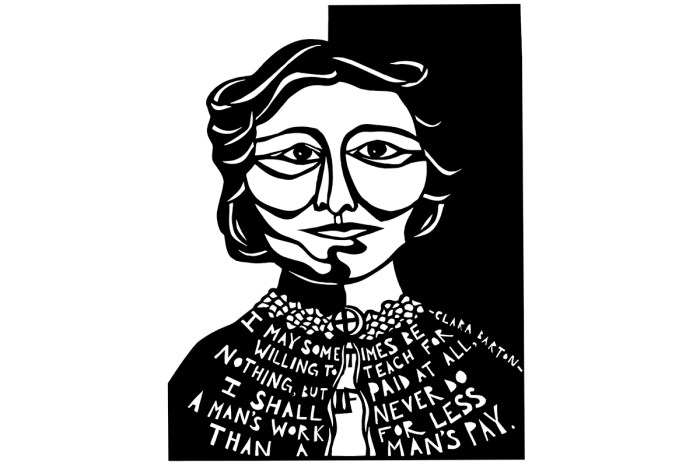
“I may sometimes be willing to teach for nothing, but if paid at all,
I shall never do a man’s work for less than a man’s pay.”
-Clara Barton (1821-1912)
Educator and humanitarian Clarissa “Clara” Harlowe Barton is most famously known for founding the American Red Cross.
She was also a strong supporter of women’s suffrage, and her quote is a reminder of how long we have been fighting to receive equal payment for work. She had started teaching at the age of 18, and even founded a school for workers’ children at the mill where her brother worked. She went on to establish the first free school in 1852, in Bordentown, New Jersey. It was at this school that she learned that a male colleague who had been hired was earning double her salary. She quit.
In 1861 she began carrying supplies to Union soldiers, making it her mission to help those in need. While she had no formal training, her care and attentiveness earned her the title “angel of the battlefield.” It was after the war that she went to Europe, where she learned of the work of the International Red Cross, an organization which called for international agreements to protect the sick and wounded during wartime and for the formation of national societies to give aid voluntarily on a neutral basis. When she returned, she was committed to starting a US-based organization that would be part of the same network, founding the American Red Cross in 1881. For the rest of her life, she continued to be a tireless advocate of those in need.
Her home in Maryland became a National Historic Site in 1975, the first dedicated to the achievements of a woman. You can learn more about Clara over on the National Women’s History Museum website.
This papercut is a part of the Women’s Wisdom Project, a project focused on showcasing the wisdom of inspiring, insightful women by making 100 papercut portraits.
Wangari Maathai
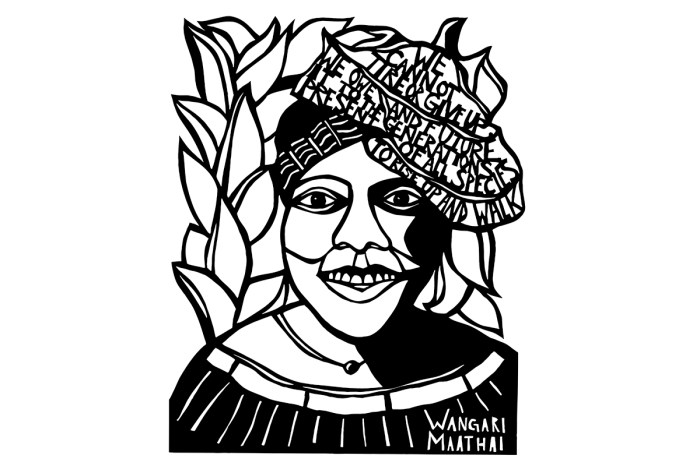
“We cannot tire or give up. We owe it to the present and future generations of all species to rise up and walk!”
-Wangari Maathai
Born in rural Kenya, Wangari Maathai was the first woman in East and Central African to earn a doctorate degree, which she was granted from the University of Nairobi in 1971. In the late 1970s and early 1980s, she served on the National Council of Women of Kenya. It was here that she came up with the idea of planting trees, a concept that she grew into a large scale, grassroots organization, the Green Belt Movement, focused on conserving the environment and improving the lives of women. Planting trees meant planting hope, a form or protest and renewal, fighting oppression with growth.
Environmentalist. Activist. Human rights advocate. Writer. Her work was inspired by her roots, but reached a global audience, and in 2004 she was awarded the Nobel Peace Prize.
I was recently reading Terry Tempest Williams’ book When Women Were Birds, and learned that the two had met in the early 1980s, and Wangari had become mentor of Terry’s. Terry herself had been inspired to start the Green Belt Movement of Utah.
Terry writes, “When I once asked her what she had learned from planting trees, she said, ‘Patience.'”
That sentiment stuck with me. Patience. It’s the same sentiment that’s in Wangari’s quote above.
The patience to speak up.
The patience to listen.
The patience to rise up.
The patience to continue.
I wonder what wisdom Wangari would give to us today. I think it would still be the same. We must continue to rise up and walk. We must be patient and persistent.
This papercut is a part of the Women’s Wisdom Project, a project focused on showcasing the wisdom of inspiring, insightful women by making 100 papercut portraits.
Share What You Make

A few months ago I was visiting my friend Amy on Cape Cod. While there, we went to a cafe for lunch. It was a cozy place, the kind you could sit and read for awhile, and they had an assortment of magazines – the bright, beautiful indie ones with gorgeous photos, you know the kind. I happened to have a copy of Comestible (the food journal that I publish) with me, and I stashed it in the pile, my own small act of guerrilla marketing.
Thanks to Instagram, I found out that a few weeks ago, someone happened upon it while visiting the same cafe. The person was so moved by it that she wrote about it on her blog. The entry was titled “Hope.”
Here is an excerpt:
“While I waited for my breakfast, I paged through a short stack of literary journals with titles I didn’t recognize. Some were rich in bold, brash photography, but one in particular — a collection of essays and poetry called Comestible — stood alone. Stark in detail and void of ads, each page is an unvarnished offering from writer to reader.
The candor and vulnerability present in every piece reminded me that sometimes life on Earth is beautiful and sometimes it’s sufferable; expecting it to be different is the real mistake. Also, though our creations will be flawed, we should share them anyway. Doing so is a reminder to self and other that we are alike more than we differ. To create is to live, and to share what we make is to offer hope and healing from the inside out.”
I was so touched by her words, and it was the reminder that I needed that whatever we put into the world inevitably has an impact.
Creating, whatever our medium is – words, painting, dance, food – can often feel like a personal act, something that we do because it sustains us. I know that I write and make art because I just feel that I need to, it’s how I process the world around me. It’s what keeps me balanced and sane.
But when we share what we create, we have the opportunity to impact someone else. That might be someone that we know, or it might be a total stranger. Those moments of exchange can be small and individual, or larger, but regardless of their size, they are all meaningful.
What if as part of our creative practice, we included a sharing practice? Not to show off our work, not in the hopes of getting acclaim, but simply to bring joy to someone else.
We all have the power to inspire each other, to encourage each other, to help each other heal. In a time where it feels like we need more of that, why not take time for the little acts which do just that?
Marion Nestle

“Food choices are about your future and that of your children.
They are about nothing less than democracy in action.”
-Marion Nestle
Marion Nestle is one of the leading thinkers and activists when it comes to nutrition and food politics. In fact it’s hard to do any reading or research about food politics without coming across her name.
She is the author of several books, including Food Politics: How the Food Industry Influences Nutrition and Health and the most recent Soda Politics: Taking on Big Soda (and Winning).In October, she will release her latest book: Unsavory Truth: How Food Companies Skew the Science of What We Eat. She is Paulette Goddard Professor, of Nutrition, Food Studies, and Public Health, Emerita, at New York University, which she chaired from 1988-2003 and from which she retired in the end of 2017.
There was a point in my life when I debated on applying to NYU’s Master’s Program in Food Studies (a program she pioneered), just so that I could have the opportunity to have Marion as a teacher. And while I never got around to that, she has kindly answered various interview questions of mine over the course of many years as I have written about food and nutrition myself.
The quote that I decided to use for her portrait is from her book What to Eat. The book was originally published in 2006. That feels like an eternity ago when it comes to food politics. After all, it feels like a lot has changed in our conversation about food over the last decade. There are many more options at the grocery store, and the conversation about health has begun to shift to not only our personal self, but that of the environment and the workers who put food on our table.
And yet despite some of the progress that we have made, we still face many of the same problems, and some have gotten worse. Over the last decade, obesity rates have jumped. In 2007-2008, the CDC reported that 33.8% of American adults were obese. For the period of 2015-2016, that number grew to 39.8%. Food insecurity has grown a small amount as well; today 12.3% of American households are food insecure, compared to 10.9% in 2006. Some of us may have easier access to things like farmers markets, and yet, independent farmers are struggling; in the U.S. the suicide rate is double that of veterans. Systemic racism and economic inequities continue to plague the food system.
In researching this piece, I came across an interview with Marion on Civil Eats, taking a look back at her three decades of work and what has changed and what hasn’t. It’s a reminder that even when it comes to our conversation about food, the basics are still the same.
I went into nutrition in 1976. And everybody was saying, I remember quite vividly, “We want you to teach this nutrition class because there’s so much public interest in it.”
Three books had just come out. Frances Moore Lappé’s Diet for a Small Planet, which is still in print, was cataclysmic in its impact. I mean, think about what she talked about in 1975: Eat less meat, and it’ll be good for health and the environment. You know, we’re still right there.
So what’s keeping this from truly moving forward? The combination of a food and agribusiness industry that’s about high profits and high margins that don’t consider things like human and environmental health, and the political policies that are at the base of that system. Real change requires industry, infrastructural and political change.
That feels overwhelming. But what we as citizens do have control of on a daily basis is what we put into our bodies, and I keep coming back to Marion’s quote from What to Eat. Not everyone has the luxury of making choices about food, but for those of us who do, they are a way to take daily action. What we eat matters, to both ourselves and our communities.
Marion continues to be a resource yet she always provides a fresh voice. She updates her Food Politics blog regularly, and as someone who cares strongly about food and the food system, for me, she is a constant source of inspiration and wisdom.
She kindly answered a few Women’s Wisdom Project Q&A questions.
Anna: What does wisdom mean to you?
Marion: Wisdom to me means knowing enough about people and history to make thoughtful decisions about daily life.
Is there an influential woman in your life who passed along a piece of wisdom to you? Who and what?
A dean in my high school assured me that I would have a much better time as an adult.
We have been eating food for all of human history, and yet today, it seems like these days we need specialists to inform us what we should and shouldn’t eat. Do you think that we have lost our common sense in regards to what we eat? If so, why?
The food industry spends fortunes to convince us that our common sense is wrong. It’s hard to resist that kind of propaganda.
When it comes to food and food production, as we have modernized, what wisdom do you think that we have lost?
If we are to eat well in the future, we must grow food sustainably, replenish soil, preserve water quality, and do everything we can to reduce greenhouse gas emissions.
What do you see as the future of food?
No matter how many of us there are, we will still need to eat. We must plan for that.
What wisdom would you share with your younger self?
Courage!
This papercut is a part of the Women’s Wisdom Project, a project focused on showcasing the wisdom of inspiring, insightful women by making 100 papercut portraits.
How to Plan a Swedish Midsummer Dinner
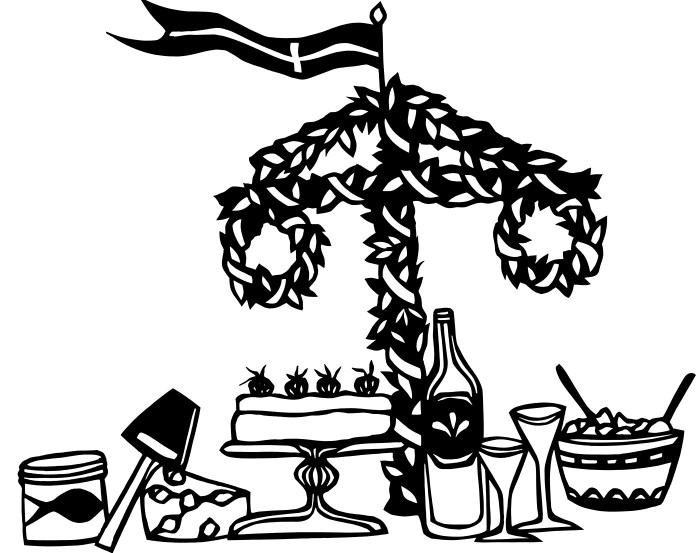
Swedish midsommar is the celebration of the summer solstice, a time to honor the endless hours of daylight.
I often get asked what to do for midsummer. There’s no one “right” way to celebrate midsummer, although there are a few common foods and activities that tend to be involved (like putting up a midsummer pole and singing and dancing).
Above all, midsummer is a celebration of the season, a time to take a break, be with friends, indulge in good food and honor the beginning of summer days.
For me, food is at the center of midsummer. It’s a time to showcase seasonal abundance; strawberries, fresh herbs and produce. If you’re looking to host your own midsummer dinner this year (the main event is midsummer eve, this year on Friday June 22nd), here are a few tips and food ideas.
 blog.annabrones.com