Archive for the ‘Women’s Wisdom Project’ Category
Marion Nestle

“Food choices are about your future and that of your children.
They are about nothing less than democracy in action.”
-Marion Nestle
Marion Nestle is one of the leading thinkers and activists when it comes to nutrition and food politics. In fact it’s hard to do any reading or research about food politics without coming across her name.
She is the author of several books, including Food Politics: How the Food Industry Influences Nutrition and Health and the most recent Soda Politics: Taking on Big Soda (and Winning).In October, she will release her latest book: Unsavory Truth: How Food Companies Skew the Science of What We Eat. She is Paulette Goddard Professor, of Nutrition, Food Studies, and Public Health, Emerita, at New York University, which she chaired from 1988-2003 and from which she retired in the end of 2017.
There was a point in my life when I debated on applying to NYU’s Master’s Program in Food Studies (a program she pioneered), just so that I could have the opportunity to have Marion as a teacher. And while I never got around to that, she has kindly answered various interview questions of mine over the course of many years as I have written about food and nutrition myself.
The quote that I decided to use for her portrait is from her book What to Eat. The book was originally published in 2006. That feels like an eternity ago when it comes to food politics. After all, it feels like a lot has changed in our conversation about food over the last decade. There are many more options at the grocery store, and the conversation about health has begun to shift to not only our personal self, but that of the environment and the workers who put food on our table.
And yet despite some of the progress that we have made, we still face many of the same problems, and some have gotten worse. Over the last decade, obesity rates have jumped. In 2007-2008, the CDC reported that 33.8% of American adults were obese. For the period of 2015-2016, that number grew to 39.8%. Food insecurity has grown a small amount as well; today 12.3% of American households are food insecure, compared to 10.9% in 2006. Some of us may have easier access to things like farmers markets, and yet, independent farmers are struggling; in the U.S. the suicide rate is double that of veterans. Systemic racism and economic inequities continue to plague the food system.
In researching this piece, I came across an interview with Marion on Civil Eats, taking a look back at her three decades of work and what has changed and what hasn’t. It’s a reminder that even when it comes to our conversation about food, the basics are still the same.
I went into nutrition in 1976. And everybody was saying, I remember quite vividly, “We want you to teach this nutrition class because there’s so much public interest in it.”
Three books had just come out. Frances Moore Lappé’s Diet for a Small Planet, which is still in print, was cataclysmic in its impact. I mean, think about what she talked about in 1975: Eat less meat, and it’ll be good for health and the environment. You know, we’re still right there.
So what’s keeping this from truly moving forward? The combination of a food and agribusiness industry that’s about high profits and high margins that don’t consider things like human and environmental health, and the political policies that are at the base of that system. Real change requires industry, infrastructural and political change.
That feels overwhelming. But what we as citizens do have control of on a daily basis is what we put into our bodies, and I keep coming back to Marion’s quote from What to Eat. Not everyone has the luxury of making choices about food, but for those of us who do, they are a way to take daily action. What we eat matters, to both ourselves and our communities.
Marion continues to be a resource yet she always provides a fresh voice. She updates her Food Politics blog regularly, and as someone who cares strongly about food and the food system, for me, she is a constant source of inspiration and wisdom.
She kindly answered a few Women’s Wisdom Project Q&A questions.
Anna: What does wisdom mean to you?
Marion: Wisdom to me means knowing enough about people and history to make thoughtful decisions about daily life.
Is there an influential woman in your life who passed along a piece of wisdom to you? Who and what?
A dean in my high school assured me that I would have a much better time as an adult.
We have been eating food for all of human history, and yet today, it seems like these days we need specialists to inform us what we should and shouldn’t eat. Do you think that we have lost our common sense in regards to what we eat? If so, why?
The food industry spends fortunes to convince us that our common sense is wrong. It’s hard to resist that kind of propaganda.
When it comes to food and food production, as we have modernized, what wisdom do you think that we have lost?
If we are to eat well in the future, we must grow food sustainably, replenish soil, preserve water quality, and do everything we can to reduce greenhouse gas emissions.
What do you see as the future of food?
No matter how many of us there are, we will still need to eat. We must plan for that.
What wisdom would you share with your younger self?
Courage!
This papercut is a part of the Women’s Wisdom Project, a project focused on showcasing the wisdom of inspiring, insightful women by making 100 papercut portraits.
Isabella L. Bird

“Everything suggests a beyond.”
– Isabella L. Bird
Born in England in 1831, Isabella L. Bird was outspoken from a young age. For health reasons, in 1854 a doctor suggested a sea voyage. This would lead to a life of travel, her adventures taking her to the U.S. (where she spent time in Colorado, riding horseback across the Rockies), Australia, India, Kurdistan, Turkey, Morocco and many more.
Bird wrote about her adventures in several books, likeA Lady’s Life in the Rocky Mountains, and was a respected photographer and naturalist, exploring and documenting the world around her. In 1892, she became the first woman fellow of the Royal Geographical Society.
Imagine being a female adventurer in her day – a time when women were expected to stay home, to stick to their routines. She upended all of those expectations, fueled by an interest in adventure and a desire to tackle new challenges. In Colorado, she became the first woman to climb Long’s Peak, nowadays one of the state’s most popular “fourteeners.”
It’s so easy to only focus on the minutiae of the world around us; our to do lists, our daily lives, our routines. But Isabella’s quote is a reminder that there is always more; a challenge to open our eyes, to look beyond, to think differently. The world is full of potential for discovery, whether it’s far away or in our own backyard. We simply have to open ourselves to it.
This papercut is a part of the Women’s Wisdom Project, a yearlong project focused on showcasing the wisdom of inspiring, insightful women by making 100 papercut portraits.
Annie Londonderry
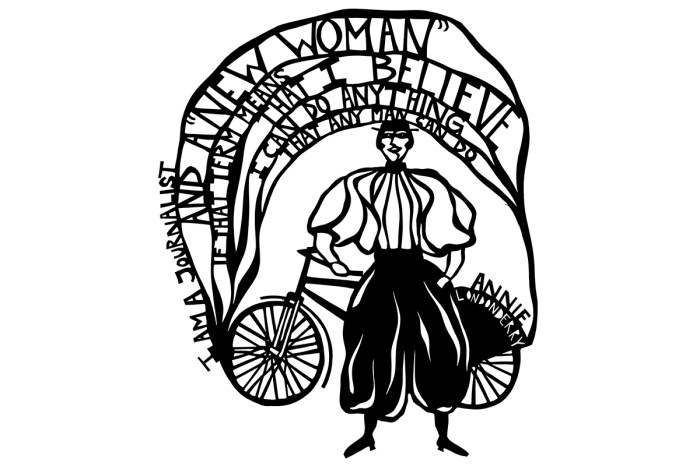
“I am a journalist and ‘a new woman’ if that term means that I believe I can do anything that any man can do.” – Annie Londonderry
I learned of Annie Londonderry several years ago in Peter Zheutlin’s book Around the World on Two Wheels: Annie Londonderry’s Extraordinary Ride.
Born in 1870 in Latvia, Annie “Londonderry” Cohen Kopchovsky was the first woman to cycle around the world. Despite never having ridden a bicycle before, in 1894 she set off on an adventurous journey, promising to circle the globe in 15 months (with the help of a few trains and boats too).
She pedaled off with a change of clothes and a revolver, and in exchange for $100, promised to place a placard for the Londonderry Lithia Water Company on her bicycle. Today, sponsorship might be the norm for many grand adventures, but at the time, it certainly challenged the era’s gender norms.
The 1890s were a time when the bicycle was intricately linked to feminism, and as Annie set out she became a symbol of the movement. Annie was a savvy storyteller and promoter, telling tales wherever she went, some true and some not-so-true. Eventually, she completed her journey, calling it “the most extraordinary journey ever undertaken by a woman.”
After her return, she wrote a column for New York World, with the byline “The New Woman.”
What was a “new woman” in the late 1800s might be seen as a modern woman today, and yet, we still struggle with some of the obstacles Annie faced over 100 years ago. Annie left three children behind to take off on her journey; today female athletes and adventurers are often questioned about their mothering skills, and can experience severe gender bias. Women suffer from a pay gap, both in sponsorship and professional sports salaries. In some countries it’s still considered improper for a woman to ride a bicycle.
Annie is reminder that society doesn’t get to dictate who we are or what we do. We can set our own goals and our own definitions of success. We can be who we want to be.
This papercut is a part of the Women’s Wisdom Project, a yearlong project focused on showcasing the wisdom of inspiring, insightful women by making 100 papercut portraits.
Rachel Carson
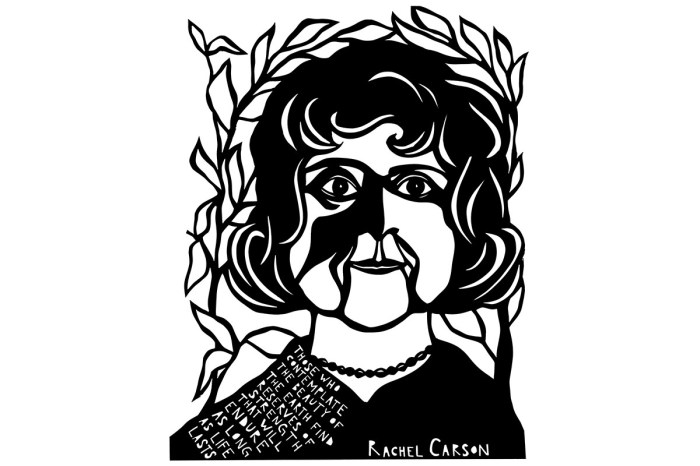
Writer, scientist, ecologist, conservationist, activist. Rachel Carson was many things, and her work continues to be instrumental today.
Her book Silent Spring, published in 1962, galvanized the environmental movement (and also pissed off the chemical industry; Monsanto published 5,000 copies of a brochure parodying the book). But her writing extended far beyond that. In fact, she was first published at the age of 10 in a children’s magazine. She was a woman ahead of her time; in 1936, she was the second woman hired by the U.S. Bureau of Fisheries.
Carson believed in the wonderment that comes from the natural world, and she sought to share that with her readers, reminding us that we are but a part of the larger system around us.
The quote that I used in this portrait of hers is part of a longer one from Silent Spring, and I wanted to share in its entirety:
“Those who contemplate the beauty of the earth find reserves of strength that will endure as long as life lasts. There is something infinitely healing in the repeated refrains of nature — the assurance that dawn comes after night, and spring after winter.”
And if we contemplate and understand the beauty of the earth, it becomes that much harder to continue to act in a way that destroys it.
This papercut is a part of the Women’s Wisdom Project, a yearlong project focused on showcasing the wisdom of inspiring, insightful women by making 100 papercut portraits.
Constance Okollet
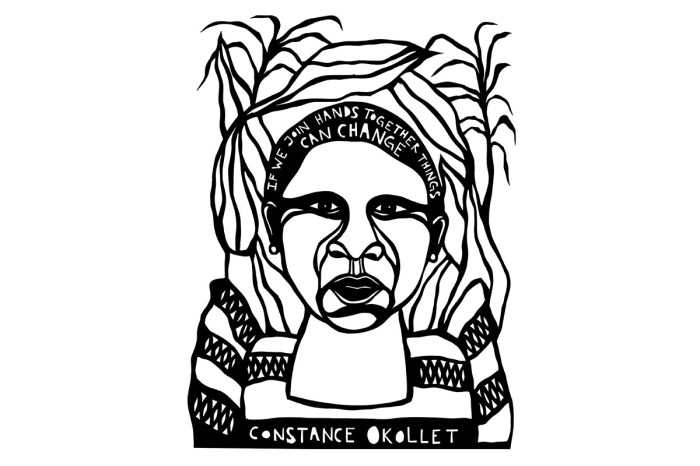
“If we join hands together, things can change.”
-Constance Okollet
Several years ago I was honored to be on a panel at SXSW Eco with Constance Okollet. Constance is a farmer from Uganda, and she has been instrumental in not just organizing fellow farmers in her region, but taking a stand against climate change on an international level.
Constance, like many other female farmers around the world, feels the effects of climate change first hand. In fact, climate change disproportionately affects women. According to UN Women, “it’s the world’s poorest and those in vulnerable situations, especially women and girls, who bear the brunt of environmental, economic and social shocks. Often, women and girls are the last to eat or be rescued; they face greater health and safety risks as water and sanitation systems become compromised; and they take on increased domestic and care work as resources dwindle.”
Constance, and the work of fellow women in Uganda to help their communities better adapt to the effects of climate change, was recently featured in an article in Sierra Magazine. The article reminded me of her work and inspired me to select her as one of the 100 women to profile in the Women’s Wisdom Project because I think that she very much represents the struggle of women agricultural workers around the globe, and their intersection with environmental policy.
Climate change is closely connected to gender equity, and climate policy needs to take gender issues into account. Today, the average representation of women in national and global climate negotiating bodies is less than a third. And yet, according to the UN, “rural women make up over a quarter the world population and majority of the 43 per cent of women in the global agricultural labour force.”
Women like Constance need a place at the decision making table. Women plant the seeds and reap the harvests. They ensure food security and climate resilience. Empowering them, ensuring that they have access to land, and access to the decision making tables, means tackling climate chance head on. There are initiatives and organizations focused on the idea that by empowering women, we could in fact reduce climate change, like Women’s Environment and Development Organization, Gender CC – Women for Climate Justice and UN Women.
As Okollet says, “if we join hands together, things can change.”
This papercut is a part of the Women’s Wisdom Project, a yearlong project focused on showcasing the wisdom of inspiring, insightful women by making 100 papercut portraits.
Astrid Lindgren

“Give the children love, more love and still more love – and the common sense will come by itself.”
– Astrid Lindgren
Usually when I make papercuts I need silence. I can’t listen to podcasts because it’s hard to focus on both the words and the cutting at the same time. After all, quiet is good for the creative brain.
But as I started to work on this one of Swedish author Astrid Lindgren, I realized that I wanted to know what Lindgren sounded like, I wanted to know what she had to say besides a list of her quotes that I had compiled. So I found an interview with her from 1993.
As I cut and listened, I realized that her voice, her words, her story, it was all magical and comforting, evoking the same emotions that I associate with growing up in a half-Swedish household. She talked of nature, her own childhood, her first time going to the Stockholm library, her home in Skärgården (the Stockholm archipelago, which would later become the central point of her series Vi på Saltkråkan, but only after she had spent several decades living there, an acknowledgment that to write about a place you must know it) and she sang. In moments, she sounded like my own Swedish grandmother.
I found myself with tears in my eyes as the interview drew to a close. My personal connection to Sweden – besides language, besides family, besides friends – is very much tied to the magical world of books, those by Lindgren and another literary great Elsa Beskow. It was a world filled with exploration, adventure, nature, enjoyment, simplicity, and growing up in the Pacific Northwest, it was a link to the Swedish part of me.
It was a world that took inspiration from Lindgren’s childhood home Vimmerby, the memories and landscapes of her own life translated onto the pages and making their way into millions of children’s rooms around the globe.
I have donated many books from my childhood, but all of my Swedish ones remain. Their pages are filled with their own worlds, worlds that comfort and that inspire. When asked if she would ever start writing “real” books, Lindgren responded, “I want to write for a readership that can create miracles. Children create miracles when they read. That’s why children need books.”
Lindgren is of course most well known for Pippi Longstocking. When I read Pippi as a child, I never specifically thought about the fact that she was a central female character. I just liked the books because they were fun and unexpected. But as I have grown older, I have been reminded of the value of seeing a female heroine, one who is adventurous, strong, funny, courageous.
I came across a great Pippi Longstocking quote yesterday:
‘He’s the strongest man in the world.’
‘Man, yes,’ said Pippi, ‘but I am the strongest girl in the world, remember that.
In this context it means physical strength, but I think Pippi also embodies emotional strength. Strength is of course not the only thing that we as women can strive for, but there is value in seeing a girl take on the world around her with no fear. Even today, I still need that.
“Astrid touched the everyday Swede,” wrote Suzanne Öhman-Sundén, co-editor of a book on Lindgren’s public influence. “There was a combination of common sense, straightforwardness and warmth in everything she did, which made her unique.”
But Lindgren’s influence has today gone far beyond just Sweden. As of 2017, there are as many as 101 different translations of her books. And that means that still today, children – and even adults – have the ability to step into her world.
“Everything great that ever happened in this world happened first in somebody’s imagination,” Lindgren said in a reception speech for the H.C. Andersen award. I would say that love and imagination are two of our most powerful tools, and we have Lindgren to thank for them.
This papercut is a part of the Women’s Wisdom Project, a yearlong project focused on showcasing the wisdom of inspiring, insightful women by making 100 papercut portraits.
In the Footsteps of Creative Women
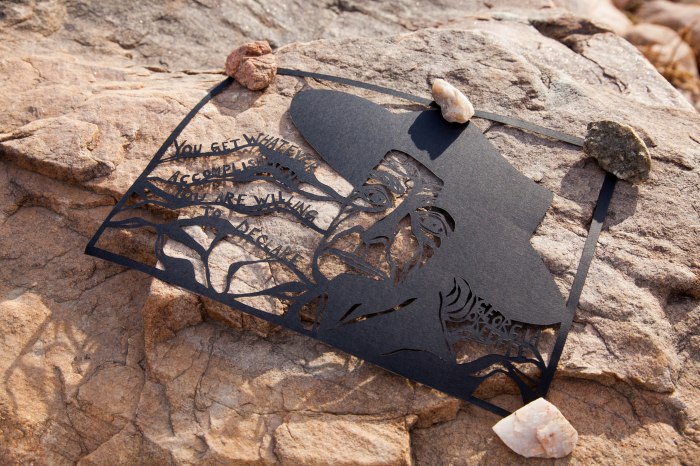
I’ve always been drawn to the Southwest. Perhaps it’s because there are so many stark contrasts to my native Pacific Northwest. Lush, wet greens replaced by dusty pinks, light and dryness instead of wet grays. The reasons that I love the landscapes of the Pacific Northwest are also what drive me to seek out places elsewhere, not because I am trying to replace them, but because I am so inspired by the differences to be found elsewhere.
The colors of the sky, intense and dusty all at the same time. The smell of sage brought out by the heat of the sun. That feeling of the desert resonates with me, even though I’ve never lived there, and perhaps never will.

I am not the only one to have drawn inspiration from that landscape.
“I found out that the sunshine in New Mexico could do almost anything with one: make one well if one felt ill, or change a dark mood and lighten it. It entered into one’s deepest places and melted the thick, slow densities. It made one feel good. That is, alive.”
That’s a quote from Mabel Dodge Luhan, a woman with a colorful history who in the early 1900s made her way to Taos, New Mexico. She fell in love with Antonio Luhan, a Taos Pueblo Indian, and eventually they bought a plot of land and built a house on it. It started as a four-room adobe, but expanded to seventeen rooms, the Luhans wanting to create a space that was inviting to those with a creative spirit.
Dolores Huerta
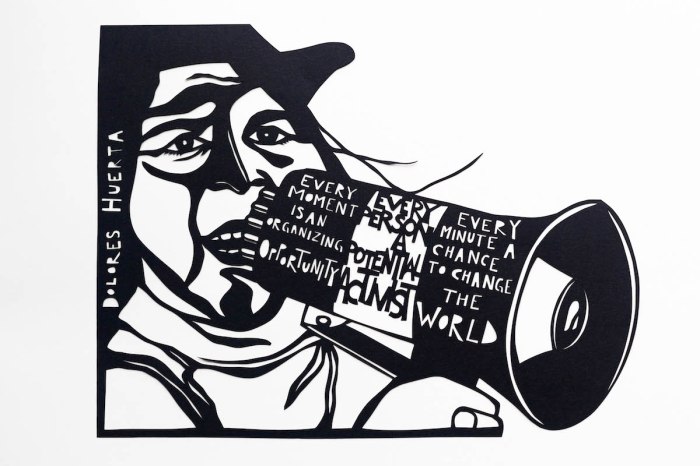
“Every moment is an organizing opportunity,
every person a potential activist,
every minute a chance to change the world.”
– Dolores Huerta
What do we do with the precious time in our lives? Do we consume instead of creating? Are we passive instead of active? Do we succumb to the darkness or do we stand up to it? I think that this quote, from Dolores Huerta, the labor leader and activist who co-founded the National Farmworkers Association, is a reminder of the opportunities that can be found in even the smallest moments.
Born on April 10, 1930, Huerta is still active today, and is the founder and president of the Dolores Huerta Foundation. Last year at the Mountainfilm festival in Telluride, Colorado, I not only had the chance to see the amazing documentary “Dolores,” which is all about her life, but also hear Huerta speak in person. Her energy was inspiring, and it was a reminder that every moment in our lives is an opportunity to take action, and we can continue to do so for as long as we live.
It’s easy to think of “activists” as people who are very visible or take bold actions. But as human beings, global citizens and community members, I believe that we all have a chance to be an activist in our everyday lives, choosing to stand up for what we believe in, no matter what the scale or what our platform is.
Every minute is a chance to change the world. What will you stand for?
This papercut is a part of the Women’s Wisdom Project, a yearlong project focused on showcasing the wisdom of inspiring, insightful women. If you want to support this work, consider doing so on Kickstarter.
Women’s Wisdom Project
Going into this year, I knew that I wanted a bigger project to work on. A couple of months ago I had made a few papercuts inspired by the Unsung Heroines Instagram account, run by Molly Schiot, author of Game Changers: The Unsung Heroines of Sports History. As I was working on those papercuts, going through an assortment of portrait photos and quotes for inspiration, I started thinking about all that the women of past and present have to offer. What insight do they have? What can they teach us?
I thought about a collection of papercuts, each done as a portrait of a woman, and paired with a quote of something that she had once written or said. The idea would be to compile the wisdom of many women through art.
And so the seed for the Women’s Wisdom Project was planted.
During the month of January, Kickstarter is running the Make 100 campaign, an initiative to focus on editions of 100. This seemed like the perfect opportunity to launch the Women’s Wisdom Project. Starting this month, I’m committing to making 100 papercuts this year, documenting a variety of amazing women and what we have to learn from them.
Over the course of the year, I am certain that the project will continue to develop (zine? book? calendar?) but this is a way for you to support in the initial stages, and if you are interested in doing so, you can check out the Kickstarter campaign here. There are limited edition cards and prints available as well as some other fun items.
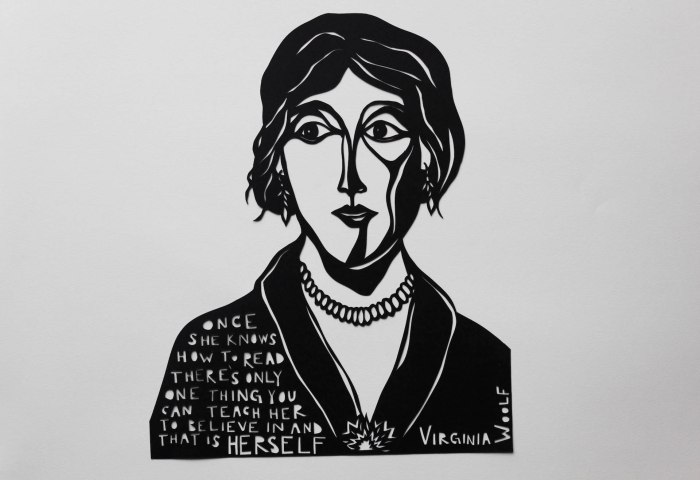
Above is a papercut I made last week, in honor of Virginia Woolf’s birthday. “Once she knows how to read there’s only one thing you can teach her to believe in and that is herself,” Woolf wrote.
Women deserve to be heard, we deserve to have a voice. Hearing the voices of others also empowers us to find our own. This is why I want to create work to showcase women from around the world – and throughout history – and their wisdom.
Supporting this work means supporting the work of women throughout the ages and amplifying their voices. The project will honor women of the past and women of the present, and I would also like this project to inspire community support for women overall, encouraging people to support women’s work in their local communities.
Throughout the course of the project, I will highlight these stories and the artwork right here on my website, in my newsletter and on social media channels. You can check out #womenswisdomproject on Instagram.
I look forward to working on this project and to sharing it with all of you.
Florence Griffith Joyner
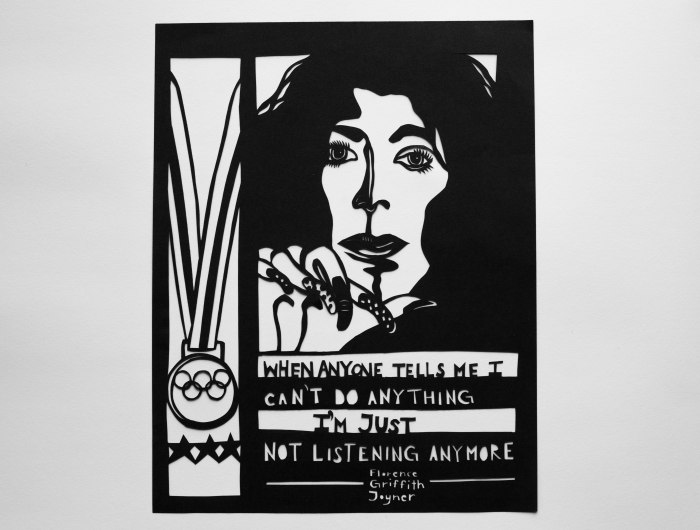
“When anyone tells me I can’t do anything, I’m just not listening any more.”
― Florence Griffith Joyner
This papercut is a part of a series that I am slowly working on called Women’s Wisdom, featuring women throughout history and what we can learn from them.
Have any ideas of women who should be featured? Let me know in the comments.
 blog.annabrones.com